HATS Directory Scheme#
You can read in more detail about the parts of the HATS directory structure in the IVOA Note. This page provides a summary of what you can expect inside a HATS-structured catalog.
Partitioning Scheme#
We use healpix (Hierarchical Equal Area isoLatitude Pixelization) for the spherical pixelation, and adaptively size the partitions based on the number of objects.
In areas of the sky with more objects, we use smaller pixels, so that all the resulting pixels should contain similar counts of objects (within an order of magnitude).
The following figure is a possible HATS partitioning. Note:
darker/bluer areas are stored in low order / high area tiles
lighter/yellower areas are stored in higher order / lower area tiles
the galactic plane is very prominent!
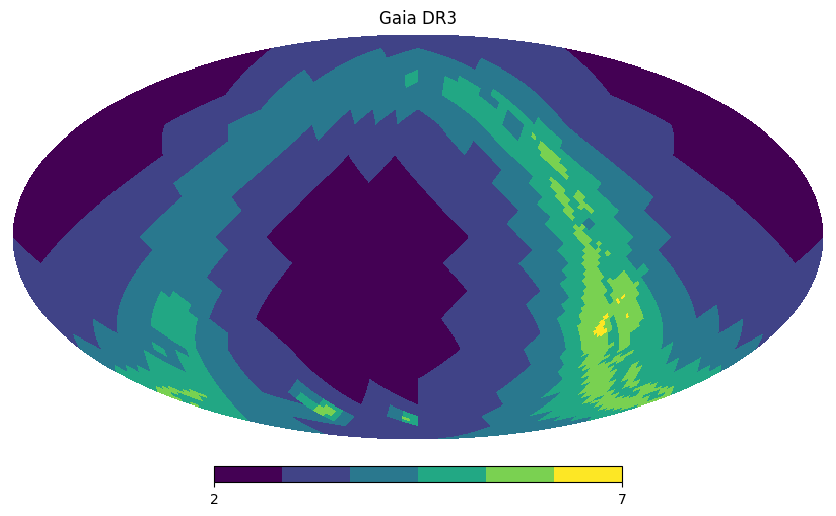
A possible HEALPix distribution for Gaia DR3.#
File structure#
The catalog reader expects to find files according to the following partitioned structure:
As you can notice, dataset/ has the following heirarchy:
Norder=kdirectory contains all tiles of the HEALPix orderk.Dir=mdirectory contains tiles grouped by their pixel numbers, wheremis the result of integer division of the pixel number by 10,000. This avoids directories becoming too large for some file systems.Npix=nis the leaf node containing data for a tile with HEALPix pixel numbernat orderk. Note: instead of being a single Parquet file, this can be a directory containing one or more Parquet files, representing a single data partition, i.e., they should be read together as a single data unit.
Collections#
HATS also makes use of supplemental tables for catalogs, and these are grouped into catalog Collections.
The primary_catalog directory will be the same format as the catalog described above.
Here we have additional supplemental tables:
id_index- a secondary index to enable finding rows by non-spatial queriesmargin_10arcs- a cache of rows that are within a limited angular threshold around the primary catalog data partition, useful for cross-matching to catalogs with slightly different astrometry.